Elements of 4D_Myla McCartney
Time
In this article titled Elements of 4D Art and Design, the author examines and analyzes the first element of 4D design; time. The author states that while all of these elements are rooted in 4D dimensional art, height, width, and depth are also represented in the element of time. Time is described in the article as the progression of occurrences and existence following the past into the future as a reference to the idea of change, and artists utilize time as a tool to remind humanity of the limits of our existence. The author proceeds in the explanation of time by categorizing it into five differing types; measured time, running time, digital time, biological time, and experienced time. Measured time is described as the quantitative measurement of time through the massing of minutes, meals, seasons, or years. Several artists and performers will use measured time in durational pieces or events and include an image of an actual clock that synchronizes the time on the clock to the real-life current time in the museum or gallery. The author refers to running time as the total duration of a live performance or video artwork, such as a movie lasting for two hours or a video piece lasting for five minutes. Plot time is a branch of running time, and is classified as the overall time period of the movie or video artwork, such as the duration of WWII or the Great Depression. The next aspect of time is referred to as digital time, which is time measured in milliseconds and is paired with technology as an intense recognition of time. Digital time is commonly depicted in the daily lives of humans, as they grow a sense of awareness of the passing of time in instances such as the time it takes to download a game or how many minutes it takes to complete a proctored test, or how many milliseconds a runner takes to complete the 400-yard dash. The author proceeds in their description of time by mentioning biological time, or the measurement of time correlated to the body's functions including the feeling of alertness, fatigue, or hunger. This aspect of time is important in the creation of a video artwork as the artist must take into account how the audience's bodily functions are behaving during the experience of the artwork. The artist may take into account the fact that the viewers may be hungry during the viewing of the artwork and therefore include a delicious cookie or cake to stimulate the feeling of hungry in the viewer. Experienced time is the last category of time that the author mentions, and can be expressed as "subjective, psychological, implied, or perceived time" or simply the perception of time passing. This aspect of time is measured by the attention of the audience, through their feelings toward the piece such as boredom, excitement, or pain. This strand of time takes into consideration the level of significance of an event to an individual, and the manipulation of the sense of the importance of the experience to make it more engaging.
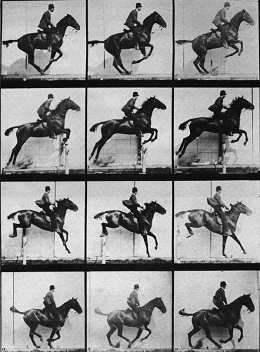
This artwork above, titled "The Horse in Motion" was created in 1878 by Eadweard Muybridge and includes a series of twelve photographs taken of the horse named "Occident" trotting at a 2-24 gait over the Palo Alto track. This artwork is the first-ever motion picture film and includes the element of time through the perceived passage of time. Although this film was taken of a horse moving through time, the sequence of photographs only captures three seconds of the horse's motion on the track. I enjoy various features of this artwork, such as the utilization of cabinet cards to reflect the sequential series of twelve different frames to capture the horse in motion. I dislike the blurry quality of this artwork and I wish it included more photographs of the horse, however, as this was created in 1878 I have no complaints. The element of time could be important as an element of 4D art, as time is forever passing regardless if the viewer is aware of it or not. Since life is constantly changing and adapting to the new eras of the time period, time is a crucial aspect in 4D art to reflect that every human is a victim of time, whether the artist directly focuses on time as a subject or simply as a byproduct of the artwork itself. I learned that this artwork was a significant turning point in entertainment, as it essentially started the art of motion picture and film as a stepping stone to endless creative possibilities.
Sound
In this article titled Elements of 4D Art and Design, the author analyzes and examines the second element of 4D design; sound. The author states that sound is classified as the "vibration that can be perceived by the ear", a vital factor in communication and our social frameworks for its aid in speaking, singing, and vocal expression. Equally vital to sound is its opposition; silence. Silence is described as the "absence of sound" or the perception of silence, as silence is implied not experienced. Due to its connotative nature, silence is utilized to amplify sound or as an outlet for expression through means of reflecting loneliness, death, etc. Sound is categorized into three areas: attack, sustain, and decay, all present in every sound created. The "attack" that occurs in a sound is mentioned as the time existing between the start of the sound and when the sound reaches its climax. Different sounds have different attack durations because the length of a sound is inconsistent. After the sound has arrived at its climax, the "sustain" is classified as the amount of time a sound remains at its climax without decay or falling out. "Decay" refers to the amount of time it will take a sound to diminish to perceived silence after its sustained state. The length of decay is dependent on the environment where sound takes place, such as under a bridge, a soundproofed room, or a house with open space. The attack and decay elements of sound reveal important information to the listener, including the distance between the sound and the listener and the speed of the sound as it comes into contact with the listeners' ears.

This artwork above, titled "Intronarumoris" was created by Italian musical experimenter, Luigi Russolo, in 1913. This small installment only pictures seven of the twenty-seven varieties of intronarumori that were built in total, all including varying names. These musical instruments are entirely acoustic, and equipped with different internal construction to create several types of noise music. While this artwork lacks much visual diversity, the sound emitted from these instruments is that of futurism and eeriness. I thoroughly enjoy this artwork for the invention of a new musical instrument that is almost unimaginable, and for the differing variations in internal construction to create the low or high-pitched frequencies. However, my only dislike is the fact that all of these instruments are played individually and are never played in unison. I would love to hear the utter chaos from playing all of these instruments in synchrony.
Movement
In the article titled Elements of 4D Art and Design, the author classifies movement as the third element of 4D artwork. The author declares movement is to be defined as "a shift or variation in the location of an object, light, or sound", utilized for highlighting a focal point within a composition. Various factors influence movement, such as shape, space, balance, energy dynamics, and gestures, and when utilized in conjunction with each other, serve as affective "descriptive or expressive intentions" generating physical or emotional reactions in viewers. Light can serve as an effective aid to creating movement in 4D art through the illusion of the expected or unexpected. The author states that three-point lighting creates expected lighting, while silhouettes and project mapping create unexpected visuals. In addition, light can be manipulated to establish both dynamic lighting through contrast and ambient/distinct lighting to emphasize moods and drama. Movement can be divided into two categories: successional movement and oppositional movement. Successional movement aims to lead the viewer's eyes in one direction as depicted in performance pieces in which all the performers gaze at a particular location in the crowd or on stage. in contrast, oppositional movement represents chaotic direction, where an assemblage leads the viewer's eyes in various directions, witnessed in group fight scenes during films. Movement collates with sound art with the repetition of three distinct parts: attack, sustain, and decay, with the addition of "base of support", defined as "the area beneath an object or person that connects with the supporting surface, such as feet or hands." furthermore, the author argues that center of gravity also affects moment, as objects with a lower center of gravity move more steadily in comparison to those with a higher center of gravity; factors such as the center of gravity aid in assessing timing, space, and topography of elements. Moreover, the author mentions additional forms of movement, including gestures, described as isolated bodily or mechanical movements typically found in dance and video artworks, to establish audience emphasis on particular movements within a work. these types of expressive movements alternate between organic and angular isolations dependent on the direction of their movement. Movement flowing in rounded shapes is organic, while straight geometric-shaped movements are angular. The author ends the discussion of movement with an analysis of its role in cinema and video. Directors allude to movement by utilizing an assortment of camera shots including pans, tilts, tracking, and zoom.


Comments
Post a Comment