Elements of 4D_Brooke
Elements of 4D
Element of Time:
Time can be described as the progression of events and existence from the past, through the present, and into the future. It can also be considered "change".
(Time can remind us of the limits on our own existence.)
Categories of Time:
Measured Time- known as actual, objective, or clock time for example minutes, meals, seasons, years, and even shadows to mark time.
(Live durational performances and events rely on actual time)
For example The Clock (2010) which is a 24 hour video lining up with real time
Experienced Time- known as subjective, psychological, implied, perceived time.
(Emotions/mood of a participant change how they perceive time.)
(Experienced time also takes into consideration the significance of an event to a given individual.)
Running Time- the total length of a live event or video piece (play time).
(Most feature-length films are between 90 mins to 2 hrs)
plot time (story time or scope): span of time plot covers within the work for examples a span of a decade or movement within the film.
Biological Time- measure of time related to bodily functions, such as when we fell awake, tired, or hungry.
Digital Time- measured in milliseconds and often associated with technology, elicits an intense awareness of time
For example a webpage taking longer to load than normal
battery life: similar in hyper-awareness of time by highlighting the length of time given battery allows you to complete a task on a piece of electronic equipment
Architecture/Topography
Nearly all principles of design plans into the creation and analysis of architecture and nearly all 4D artworks involve architecture in some way either physically or virtually depending on the medium.
(Traditional choices aren't always the best choices, take into consideration various components of your artwork and find what's most effective even if it's not traditional)
Example Artwork of the Element of Time
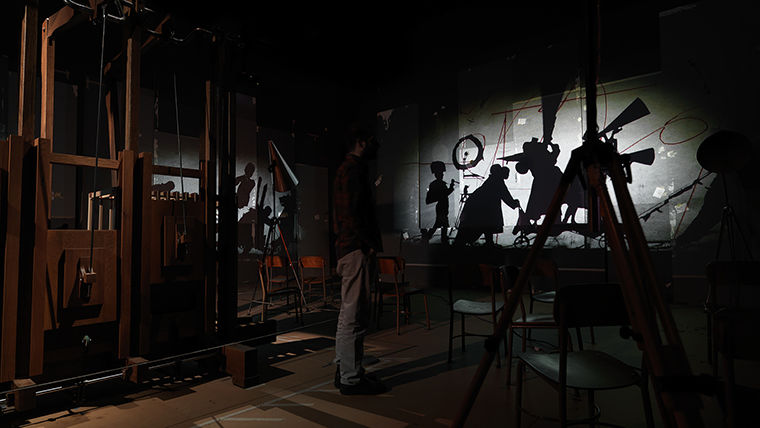
William Kentridge, The Refusal of Time (2012)
I liked this piece because it really shows actual time, the passage of time. This artwork is important as a 4D art, because it is all about time which comes in different formats such as video, sound, performance, etc. but it all time-based. I learned that the projections consisted of small animations, clocks, metronomes, etc. and their were sculptures placed around as well which gives the artwork that architectural element.
Element of Sound:
Sound is vibration that can be perceived by the ear. It is an integral part of communication and our social framework as it is used for speaking, singing, and musical expression.
Silence is equally as important as sound.
There are parts of sound: an attack (onset, growth, birth); sustain (stead-state, duration, life); and decay (fall-off, termination, death).
attack- the time between the start of the sound and when it reaches its peak.
sustain- the amount of time before it decays or falls off.
decay- the amount of time it takes a sound to diminish to silence from its sustain state.
Categorizing Sound:
Synchronous sounds- those that are timed to their source on-screen or within a designated performance space.
ex. dialogue between to people seen or a teapot whistling onstage
Non-synchronous sounds- play on-screen or onstage while their source is not currently visible but their source has been, or will be, visible.
ex. ocean off-screen after seeing it previously
sound bridge- another example of non-synchronous sound when sounds from one shot continue into the next shot or vice versa.
ex. hearing a car before cutting to the car
Asynchronous sound- sound we hear that does not match what we see.
ex. seeing a child in detention on screen while hearing children playing outside
Diegetic sounds (literal sounds)- "actual" sounds
ex. include vices of performers or characters, sounds made by objects within the work, or ambient sounds
(ambient sounds- results of movement, weight, size, solidity, resistance, contact, texture, temperature, impact, release, etc.)
Non-diegetic sounds (nonliteral sounds)- "commentary" sounds
ex. include commentary, narration, and nonrealistic sounds effects such as those in cartoons, and music that is not being performed live within the world of the work.
These two types of sound create atmosphere, determine time and place, communicate emotions, half create continuity, and set the start or end of an event.
Example Artwork of the Element of Sound

https://www.youtube.com/watch?v=3txhT2ncNOU
John Taylor Tucker, The Tucker Zone (2017)
I liked this example of 4D sound because I had listened to it before and it was incredibly immersive. The sound coming from your own head phones had a feeling of depth, direction, distance, etc. It also left the visuals up to what you interpreted based on the sounds you hear.
Element of : Movement
Movement is a shift or variation in the location of an object, light, or sound. It's a good way to direct the focus of a composition. Shape, space, levels of space, balance, energy dynamics, weight, and gestures affect movement. It serves any number of descriptive or expressive intentions, from physical to emotional reactions.
Successional movement: leads the eye in one direction
ex. pointing fingers in same direction
Oppositional movement: leads the eye in a different direction (due to a clash of forces)
ex. two characters attacking each other (movement back and forth)
*The absence of movement, or stillness, is also important to 4D work; it allows contrast*
Movement can either be observed or participatory.
ex. Observed - Chair Dance II (2012) because audience member is not directly involved
Participatory - FIND EACH OTHER. Begin There. (2012) because is requires direct participation from the player.
Movement is a trigger for action: therefore the approach, entrance into the work, path within the work, and eventual exit from the work all contribute to an individual's response to a piece.
Movement also has distinct parts like sound:
attack
ex. onset of movement, often squashing or recoiling of the object/figure into its "base support" or area beneath an object or person that connects with the supporting surface
sustain
ex. movement continues, stretches out, returning to its original shape
decay
ex. begins to stop by bouncing slightly before complete end of motion
Center of Gravity: the center of mass in an environment of uniform gravity that affects movement.
low center of gravity - move steadily
high center of gravity - seems unbalanced
gestures are movements by a part of a whole
ex. single part of the body or single part of a machine (flexing, extending, rotating, etc.)
They can be everyday or behavioral motions like drinking coffee or opening a door
They can also be expressive and non-functional like swinging your arm in a circle to show joy
Expressive isolations can vary between organic and angular in the direction of their movement.
ex. Organic - flows in rounded shapes
Angular - involves more straight geometric shapes
Movement in Film and Video:
pan - pivoting the camera from side to side
tilt - pivoting the camera up and down
(^ used to show the world of the work continues beyond the viewing frame)
tracking/dollying - camera moves parallel to the ground so the view moves as the camera moves
zoom in - move camera lense in, objects appear larger and closer
(^can draw attention to important details)
zoom out - move camera lense out, objects appear smaller and farther away
(^reveals the larger context of a scene)
*Movement is central to the effectiveness of nearly all time-based works.*
Example Artwork of The Element of Movement

https://4dart.com/en/creation/2007/norman/
Norman (2007)
Production
Lemieux Pilon 4D Art in collaboration with the Office national du film du Canada
Coproduction
Place des Arts de Montréal; Scène Québec, Centre national des arts (Ottawa); Espace Jean Legendre (Compiègne, France), and Luminato Toronto Festival of Arts and Creativity.
2007 - 2014
I liked this artwork because it was a tribute to a late animator named Normal McLaren. The team of artists used movement to connect to McLaren's animations. This works is meant to be observed and uses both successional and oppositional movement, as well as organic and angular movement.


Comments
Post a Comment